
1800W Handheld Steamer Review: Is It Worth It?
Table of Contents
- Why 1800W Matters: Power and Performance
- Top 1800W Handheld Steamer Picks
- How to Use a Handheld Steamer Effectively
- Handheld Steamer vs Iron for Clothes
- Steamer Maintenance and Descaling Tips
- What to Look For in a High-Wattage Steamer
- Conclusion
- Frequently Asked Questions
Last Updated: September 13, 2026
Why 1800W Matters: Power and Performance
An 1800W handheld steamer is a garment care appliance built around a high-wattage heating element that flashes water into steam on demand. Wattage is the size of the engine; tank, nozzle, and trigger just decide how that output reaches the fabric.

A watt is one joule per second, so 1800W means the element dumps 1,800 joules of heat into the water path every second (SP 330 - Section 2 | NIST). That speeds up two things: the element reaches steam-producing temperature sooner after you press the trigger, and it recovers faster after a burst of steam leaves the chamber. A 1500W element hits a good peak temperature, but every long trigger pull cools the chamber and it has to climb back. On an 1800W unit the dip is smaller and the climb-back shorter, so steam feels steadier across a whole shirt.
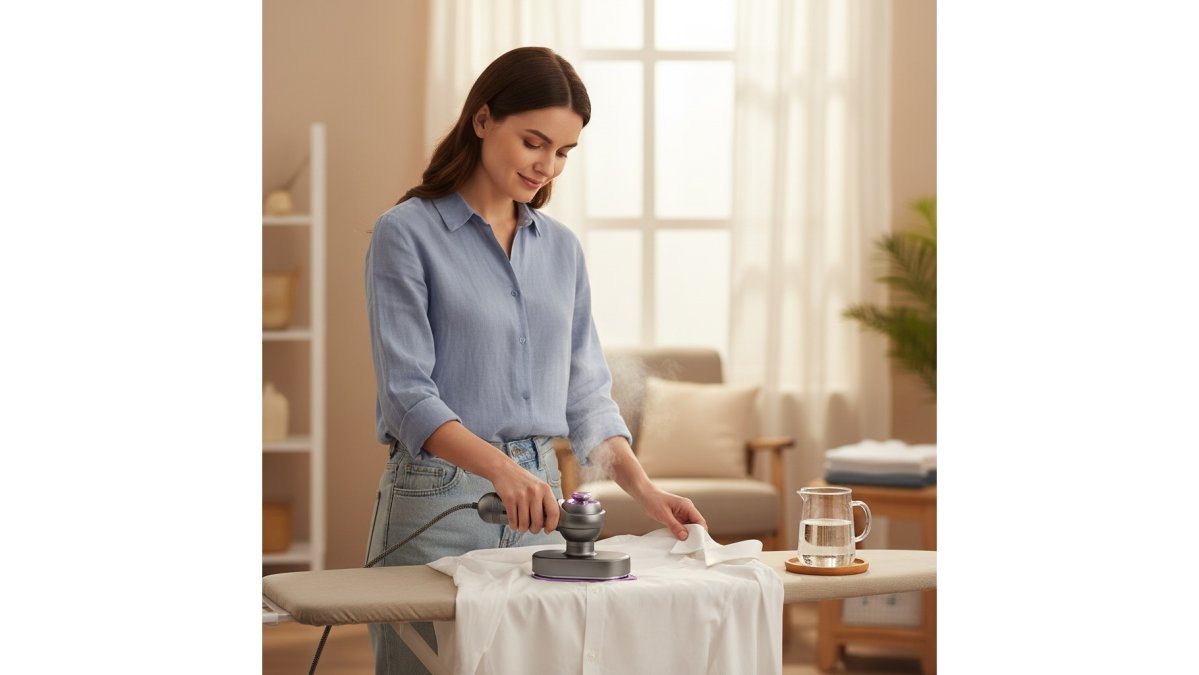
Handheld steamers typically produce steam around 212°F at the nozzle, water's boiling point at sea level, though the temperature at the fabric surface drops fast as steam expands and mixes with room air (NOAA's National Weather Service). What 1800W buys you isn't a dramatically hotter steam cloud; it's a denser, more sustained one. Denser steam carries more thermal energy per pass, so a single slow pass on a cotton dress shirt does more work on an 1800W unit than a 1500W one. That density is also why delicate-fabric technique matters: silk and many synthetics are heat-sensitive, so hold the head further off the fabric and let the steam cool slightly before it lands.
1800W is a high instantaneous draw, run continuously for an hour at a typical residential rate, it would consume roughly 1.8 kilowatt-hours. But a handheld steamer is a burst appliance, on the trigger for seconds at a time. A realistic morning session of four or five garments might total 6 to 10 minutes of actual steam time, a few cents of electricity. The honest comparison isn't 1800W versus 1500W on the bill, it's 1800W versus the 20 minutes you'd spend setting up and using an iron.
Higher wattage draws more current, fine on a standard 15-amp household circuit for a handheld, but worth knowing if you're sharing an outlet with a space heater or hair dryer (osha.gov). The other trade-off is runtime per tank. A 1800W element boils off water faster than a 1500W element from the same reservoir, so two units with identical 0.8L tanks won't deliver identical continuous-steam minutes. The higher-wattage unit gives stronger steam for a shorter window; the lower-wattage unit stretches the same water further at lower intensity.
Top 1800W Handheld Steamer Picks
The best 1800W handheld steamer for most households is the Portable Handheld Garment Steamer 1800W from Modern Goods Living, which pairs a fast-heating element with a 0.8L detachable tank and dual steam settings. The three alternatives below cover smaller budgets, tighter storage, and dual iron-and-steam needs.

| Model | Wattage | Tank | Best For | Price |
|---|---|---|---|---|
| Portable Handheld Garment Steamer 1800W | 1800W | 0.8L detachable | Full household use | $69.99 |
| Portable 1500W Handheld Garment Steamer | 1500W | 0.8L | Long sessions, tight budgets | $49.99 |
| Handheld Garment Steamer (Compact) | Not specified | Compact | Travel and small spaces | $29.50 |
| Steam Iron - Dual Function Travel Steamer | Not specified | Compact | Iron and steam in one | $38.69 |
Portable Handheld Garment Steamer 1800W
This is our top pick, and it earns the 1800W badge outright. The heating element generates continuous steam in seconds, the difference between steaming a shirt while running late and wearing something else.
What works: the 0.8L detachable water tank supports up to 20 minutes of continuous steaming, and detaching it for a sink refill beats pouring into a fixed reservoir. Two adjustable steam levels let you drop to a gentler setting for silk and wool and push full output on cotton and linen. It's safe on all ironable fabrics, and vertical steaming handles curtains and upholstery.
What doesn't: 20 minutes of runtime is generous for a handheld, but it's not unlimited. If you're steaming an entire wardrobe in one sitting, expect a refill partway through.

Portable 1500W Handheld Garment Steamer
Skip the 1800W model if runtime matters more than raw speed. This 1500W unit trades a little heat-up speed for up to 60 minutes of continuous steaming per fill from the same 0.8L tank, the longest in this lineup.
The single-gear mechanical control is the honest limitation: no delicate setting, so one steam temperature for everything from silk to denim. In practice, most people hold the steamer further from delicate fabric and closer to heavy cotton. It's also the better pick for long, uninterrupted sessions rather than quick touch-ups.
Handheld Garment Steamer (Compact)
For travelers and small-space dwellers, this compact steamer heats quickly, delivers steady continuous steam, and works on cotton, linen, polyester, and blends, most everyday wardrobes.
The compact body is the whole point: it fits in a carry-on or weekender bag without a fight. Vertical steaming refreshes a hanging dress or curtains without an ironing board, useful in a studio apartment where a board would live permanently in the way.
Where it falls short: it's built for touch-ups, not marathon sessions. If you're steaming a suit, a dress, and three shirts back to back, the larger 1800W model is the better tool.
Steam Iron - Dual Function Travel Garment Steamer
This one answers a different question: what if you don't want to choose between an iron and a steamer? The foldable handle and lightweight body make it packable, and the 2-in-1 design works as a flat iron or a vertical steamer.
It's the right pick for dorm rooms, studio apartments, and travelers who want one device instead of two, a fixed-handle iron simply doesn't pack well.
The honest caveat is that dual-function tools rarely match a dedicated unit at either job. It irons well and steams well, but a dedicated 1800W steamer will outpace it on volume.
How to Use a Handheld Steamer Effectively
Using a handheld steamer effectively comes down to three things: hang the garment, work top to bottom, and keep the head moving. Most complaints trace back to technique, not the appliance.
- Fill the tank with water and let the unit heat fully before you start.
- Hang the garment on a hanger, ideally against a door or wall rather than in open space.
- Start at the shoulders and work downward, letting gravity help.
- Keep the head a few centimeters off the fabric and move in slow, continuous passes.
- Pull the fabric taut with your free hand for stubborn creases.
- Hang the garment for a minute to let residual moisture evaporate.
A common mistake is pressing the steamer flat against the fabric and holding it still. That traps moisture and can leave wet spots. The steam needs somewhere to go.
Handheld Steamer vs Iron for Clothes
A handheld steamer beats an iron for speed, delicate fabrics, and vertical surfaces; an iron beats a steamer for sharp creases and heavily wrinkled natural fibers.
Steamers win on these:
- Delicate fabrics like silk and wool, which scorch easily under an iron
- Suits, blazers, and dresses you can't lay flat
- Curtains, drapes, and upholstery
- Speed, since there's no board to set up
Irons still win on:
- Crisp creases down a dress shirt or trouser leg
- Heavily wrinkled linen that needs pressure, not just steam
- Structured garments where you want a sharp edge
For most people, the honest answer is that a steamer handles the daily 80% and the iron comes out for interviews and weddings. That's why the dual-function option above exists.
Steamer Maintenance and Descaling Tips
Descaling decides whether a high-wattage steamer lasts two years or five, and it's the step almost every review skips. An 1800W element is actually more sensitive to scale than a lower-wattage one, not less: the same high heat density that gives fast, dense steam also bakes dissolved minerals onto the element surface faster. Scale is a thermal insulator, so as it builds, heat-up time creeps up, steam output weakens, and eventually the thermal fuse or element gives out. The failure looks sudden; the cause built up over months.
Tap water carries dissolved calcium and magnesium, and when it boils, those minerals precipitate out as carbonate deposits, the same white crust you see on a kettle. In a steamer, that crust forms on the heating element, inside the steam chamber, and around the nozzle orifices. Clogged orifices are why a steamer spits instead of steaming: water can't flash cleanly, so it exits as droplets.
How to read the early warning signs, in the order they usually appear:
- Heat-up time gets noticeably longer than it was when the unit was new
- Steam output weakens even with a full tank and a fresh fill
- The unit sputters or spits water instead of producing dry steam
- You hear a gurgling or hissing that wasn't there before
- White flakes or mineral specks appear on the fabric after a pass
If you catch it at the first two signs, a descaling cycle usually restores full performance. If you're seeing flakes on fabric, the deposits are heavy and you may need two cycles.
The routine that keeps a high-wattage steamer working:
- Use distilled or filtered water if your tap water is hard, this is the single highest-leverage habit
- Empty the tank after every use; never store it full
- Run a descaling cycle every 1-3 months depending on water hardness
- Wipe the steam head and vents with a damp cloth weekly
- Check the tank seal for wear if you notice leaking
- Let the unit cool completely before storing
For the descaling cycle itself, diluted white vinegar is the standard home approach: mix roughly one part white vinegar to one or two parts water, run a heating cycle, let it sit in the warm chamber several minutes, then flush thoroughly with clean water and run one or two plain-water cycles to clear residual vinegar smell. Check your manual first, some manufacturers specify a proprietary descaling product and a few warn against vinegar outright, so follow the manual over any general guide, including this one.
If you'd rather not mix anything, commercial descaling solutions do the same job with less guesswork, and citric acid powder dissolved in warm water is a common alternative with a milder smell.
In a hard-water area, keep a jug of distilled water next to the steamer and refill from that instead of the tap. It costs a few dollars a gallon and is cheaper than replacing a steamer every couple of years.
What to Look For in a High-Wattage Steamer
The spec that matters most is wattage, followed by tank capacity and heat-up time. Everything else is secondary.
Wattage and steam rate. Higher wattage means faster heat-up and stronger continuous steam output. For a handheld, 1500W is the practical floor and 1800W the sweet spot for home use.
Water tank capacity. A detachable tank is worth paying for, refilling becomes a 10-second job instead of a balancing act. Larger tanks mean longer sessions but add weight.
Heat-up time. Fast heat-up is the feature you'll notice every single day. A unit that's ready in seconds gets used; one that takes three minutes sits in a drawer.
Fabric compatibility. Look for adjustable steam levels if you own silk or wool. Single-gear units work, but you'll manage the heat through distance and technique rather than a dial.
Safety features. Auto-shutoff and thermal protection matter more than most buyers think, especially in households with kids or pets. A steamer left running on a counter is a real hazard.
Cord length and maneuverability. A corded unit gives consistent power, but a short cord limits where you can work. Check the length if you plan to steam near a closet rather than an outlet.
Portability. Travel-sized and lightweight designs matter if the steamer lives in a suitcase. If it lives on a shelf at home, prioritize tank size and wattage instead.
Conclusion
The gap between a steamer you use and one you abandon usually comes down to wattage and tank design, and an 1800W handheld steamer closes that gap for most households. If you want the fastest, strongest option in the lineup, the Portable Handheld Garment Steamer 1800W delivers continuous steam in seconds, a detachable 0.8L tank, dual steam settings, and vertical steaming for curtains and upholstery. Modern Goods Living curates home essentials built to last rather than be replaced. Get started with Modern Goods Living and upgrade your morning routine with garment care that actually keeps up.

Frequently Asked Questions
What is the benefit of an 1800W handheld steamer over lower wattage models?
An 1800W handheld steamer produces steam faster and maintains a higher, more consistent steam output than lower-wattage models. This means you can remove stubborn wrinkles in fewer passes, saving time on busy mornings. Higher wattage also helps the steamer recover quickly between uses, so you can work through multiple garments without waiting for the unit to reheat. For thick fabrics like denim or heavy cotton, the extra power makes a noticeable difference in how easily creases release.
Can an 1800W handheld steamer be used on delicate fabrics like silk?
Yes, most 1800W handheld steamers are safe for silk, wool, and other delicate fabrics when used correctly. Hold the steamer several inches away from the fabric and keep it moving rather than holding it in one spot. Many models include adjustable steam levels, so you can switch to a gentler setting for silk or sheer materials. Always test on a hidden area first, and avoid steaming embellishments or sequins that could be damaged by high-temperature steam.
How long does it take for an 1800W steamer to heat up?
Most 1800W handheld steamers heat up in 30 to 60 seconds, compared to the 2 to 3 minutes typical of lower-wattage models. The exact time depends on the heating element design and whether the unit uses an aluminum or ceramic heating plate. Fast heat-up is one of the main reasons people choose an 1800W steamer, especially for last-minute touch-ups before work or a meeting. You can usually hang your garment while the steamer warms up to save even more time.
Do 1800W steamers require distilled water?
Using distilled water is recommended for any handheld steamer, including 1800W models, because it prevents mineral buildup inside the heating element and water tank. Tap water contains calcium and magnesium that can clog the steamer over time, reducing steam output and shortening the appliance's lifespan. If distilled water isn't available, filtered water is a better option than straight tap water. Regular descaling with a vinegar-and-water solution also helps maintain performance between deep cleanings.
Are 1800W handheld steamers safe for travel?
Many 1800W handheld steamers are designed with travel in mind, featuring compact, lightweight bodies and detachable water tanks that make them easy to pack. However, because they draw significant power, you should check that the steamer supports dual voltage or matches the voltage of your destination. For international trips, look for a model with region-specific plug options or a travel adapter rated for high-wattage appliances. Always empty the water tank before packing to prevent leaks.
