
Best Sustainable Kitchen Gadgets for 2026
Table of Contents
- Why Sustainable Kitchen Gadgets Matter in 2026
- Quick Comparison: Top Sustainable Kitchen Gadgets
- Energy Efficient Kitchen Gadgets That Cut Your Utility Bills
- Non Toxic Kitchen Appliances for a Healthier Home
- Eco Friendly Alternatives to Paper Towels and Other Waste Reduction Tools
- Durability and Repairability: How to Spot Gadgets That Last
- Budget-Friendly Sustainable Swaps Under $50
- End-of-Life Disposal and Recycling for Kitchen Gadgets
- Frequently Asked Questions
Last Updated: September 10, 2026
Why Sustainable Kitchen Gadgets Matter in 2026
Sustainable kitchen gadgets are tools designed to reduce waste, cut energy use, and last longer than the disposable alternatives they replace. This guide breaks down sustainable kitchen gadgets for 2026, with real prices and honest trade-offs.
The shift is practical, not just ethical: a gadget you replace every year costs more than one you keep for a decade. Below, we'll show you how to spot genuine eco-friendly design versus greenwashed marketing.
Quick Comparison: Top Sustainable Kitchen Gadgets
| Gadget | Price | Best For | Key Eco Credential |
|---|---|---|---|
| Smart Air Fryer 4.5L | $139.99 | Families of 4-5 | Cuts oil use, fast heating |
| 4-in-1 Handheld Blender | $49.99 | Small kitchens | Replaces 4 appliances |
| 12-Piece Silicone Utensil Set | $24.99 | Non-stick cookware owners | Replaces disposable tools |
| Smokeless Electric Grill Pan | $45.99 | Apartments, RVs | Indoor grilling, no charcoal |
| 2-in-1 Glass Oil Dispenser | $22.99 | Air fryer and salad users | Replaces aerosol cans |
Energy Efficient Kitchen Gadgets That Cut Your Utility Bills
Energy-efficient kitchen gadgets use less power per task than the appliances they replace. A hot air cooker, for example, heats a small chamber instead of a full oven cavity, so it reaches temperature faster and runs for less time.

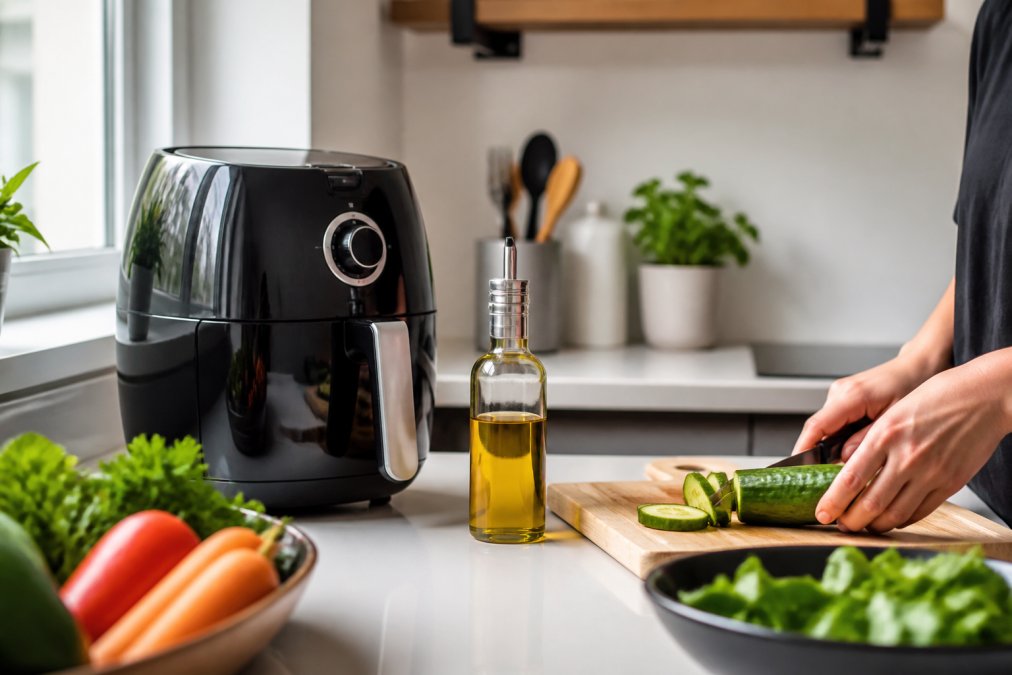
Smart Air Fryer 4.5L: Family-Size Hot Air Cooker
The Smart Air Fryer 4.5L is the strongest pick for households of four to five people. It uses hot air circulation rather than oil, and the 1250W rating is modest for its capacity. The panoramic viewing window lets you check progress without opening the basket and losing heat.
The honest limitation: air fryers still draw meaningful power, so savings come from shorter cook times and less oil. If you already own a small convection oven, the gain is smaller.
4-in-1 Handheld Blender: 800W Juicer, Mixer & Meat Grinder
One appliance replacing four is the core sustainability argument for the 4-in-1 Handheld Blender. It handles juicing, blending, prep, and meat grinding with a single 800W motor and two speed settings, so you skip a separate blender, food processor, and grinder.
It weighs 980g and stores easily. The trade-off is capacity: this is a small-batch tool, not a replacement for a full-size blender when you're cooking for a crowd.
Non Toxic Kitchen Appliances for a Healthier Home
Non-toxic kitchen appliances avoid materials that can migrate into food during normal use, particularly at high heat or after physical wear. The two biggest concerns are scratched non-stick coatings and soft plastics that sit against hot food.
The mechanism matters more than the label. PTFE non-stick coatings are stable when intact, but once a metal spatula gouges the surface, the exposed aluminum underneath can react with acidic foods like tomato sauce or citrus. The failure mode is mechanical, not chemical: the scratch changes what your food touches. Separately, many soft plastics contain plasticizers that make them flexible, and those additives are most likely to migrate when heated, scratched, or run through a hot dishwasher.
Consumer information on cookware and food-contact materials maintains the federal framework for food-contact substances, and the practical takeaway is simple: intact surfaces are the goal, and the tools you use to handle food determine whether surfaces stay intact.
12-Piece Heat-Resistant Silicone Utensil Set with Holder
This 12-piece set is the simplest non-toxic swap you can make. Food-grade silicone won't scratch coated cookware, handles high heat without warping, and comes with a storage bucket. At $24.99, it replaces a drawer of mismatched tools that shed plastic over time.
The sustainability case is durability, not novelty. Silicone tools don't absorb odors like cheap nylon, don't melt at the edge like thin plastic, and don't need replacing every time a handle cracks. One set outlasts several rounds of dollar-store utensils.
Smokeless Electric Grill Pan: Non-Stick, Portable Indoor Grill
For apartment dwellers who want grilled food without charcoal or a balcony, the Smokeless Electric Grill Pan is the practical answer. It heats evenly, runs on a standard cord, and cleans up fast thanks to the non-stick coating.
The honest caveat: "smokeless" means reduced smoke, not zero, so run your range hood for fatty cuts. The second caveat is coating care: because the pan relies on its non-stick layer, use silicone or wood tools only, no metal tongs, no scouring pads. A pan that keeps its coating for five years is a genuinely low-waste purchase; one scratched in month two is not.
Reducing Microplastic Shedding in Everyday Cooking
Microplastic shedding is the part of non-toxic cooking most roundups skip, and it is where small habit changes do the most work. Plastic sheds more when hot, scratched, or abraded, so the highest-impact swaps remove plastic from the heat path entirely.
- Move hot food off plastic. Transfer leftovers to glass or stainless steel once they stop steaming, not while they are still hot.
- Retire scratched plastic. A cutting board with deep grooves or a storage container with visible scratches is the one most likely to shed into food.
- Skip the plastic colander for pasta. Boiling water plus plastic is the worst combination in the kitchen.
- Hand-wash plastic when you can. Repeated hot dishwasher cycles age plastic faster than anything else you do to it.
- Choose glass, stainless steel, or silicone for anything that touches heat. These materials do not have the same shedding profile.
None of this requires replacing your kitchen at once. Remove plastic from the moments where heat and abrasion combine, and let the rest of your plastic items live out their useful life.
Eco Friendly Alternatives to Paper Towels and Other Waste Reduction Tools
The eco-friendly alternatives to paper towels that actually stick are the ones that live on your counter, not in a drawer. Reusable cloths, glass storage, and refillable dispensers only work within arm's reach during cooking.
EPA guidance on reducing household waste outlines the hierarchy clearly: reduce first, reuse second, recycle last. Kitchen gadgets that replace a disposable item you buy weekly deliver the biggest reduction.
2-in-1 Glass Oil Dispenser & Sprayer for Cooking
The 2-in-1 Glass Oil Dispenser replaces aerosol cooking spray cans and bulky plastic bottles in one move. Switch between a steady pour and a fine mist, coat an air fryer basket or sheet pan evenly, and refill from a larger bottle instead of buying new cans.
The light-protective glass keeps oils fresh longer, and the matte finish options look good enough to leave out. At $22.99, it offers a cost-effective alternative to aerosol sprays.
Durability and Repairability: How to Spot Gadgets That Last
Durability and repairability separate a sustainable gadget from a disposable one, and almost no roundup scores them. This section does, using a simple repairability index you can apply to anything on a shelf.
The Repairability Index: Score Any Gadget Out of 10
Score each gadget on five factors, two points each. A score of 8 or higher is a keeper; 5 to 7 is a judgment call; below 5 is a disposable item wearing a sustainable label.
| Factor | 2 points | 1 point | 0 points |
|---|---|---|---|
| Wear-part material | Stainless steel or glass | Mixed metal and plastic | Molded plastic only |
| Replaceable components | Blades, gaskets, cords sold separately | Some parts available | Sealed unit, no parts |
| Fasteners | Standard screws | Mixed standard and proprietary | Proprietary or glued |
| Electronics complexity | Single motor or heating element | Simple control board | Multiple boards, sensors, app dependency |
| Published specs | Wattage, materials, dimensions listed | Partial specs | No specs published |
A brand that publishes wattage, materials, and dimensions usually expects the product to last. A brand that hides those numbers expects you to replace the item before you notice.
Why Repairability Beats Recyclability
A gadget you repair is a gadget you never have to recycle, and that is the higher-leverage outcome. Recycling small appliances is hard because they mix plastic, metal, and electronics in a sealed housing. Repair keeps the unit in service and avoids the manufacturing footprint of a replacement.
The manufacturing footprint is the number most guides ignore. For small kitchen appliances, production typically represents a larger share of lifetime environmental impact than operation, so the most effective decision is keeping a working appliance working, not buying a more efficient one.
End-of-Life Disposal: What to Do With the Gadget You're Replacing
End-of-life disposal is where most sustainability advice stops, which is backwards. A gadget's real footprint includes what happens when it dies, and small appliances are notoriously hard to recycle because they mix plastic, metal, and electronics.

Work through this order before anything goes in the trash:
- Repair it first. Check whether the manufacturer sells the failed part. A $12 gasket is cheaper and lower-impact than a $140 replacement.
- Donate if it works. Working small appliances move quickly through donation channels and stay in service.
- Use a manufacturer take-back program. Several major appliance brands run their own collection programs; check the brand's site before assuming none exists.
- Find a small-appliance drop-off. Many municipalities run electronics or small-appliance collection events, and some accept items curbside pickup won't take. Check your local waste authority's page for the current list.
- Separate what you can. If a unit is already broken and no program will take it, remove the cord and any easily detachable metal before disposal. It is a small gain, but it keeps recoverable material out of the mixed-waste stream.
Guidance on reducing household waste and recycling electronics frames the hierarchy clearly: reduce first, reuse second, recycle last. Disposal is the final step, not the first one, and the gadgets that score highest on the repairability index are the ones least likely to reach it.
Budget-Friendly Sustainable Swaps Under $50
The best sustainable kitchen gadgets under $50 replace something you buy repeatedly. You don't need to spend big to cut waste; you need to spend once on the right item.
| Swap | Replaces | Price | Payback Period |
|---|---|---|---|
| 2-in-1 Glass Oil Dispenser | Aerosol cooking spray | $22.99 | 2-4 months |
| Digital Measuring Spoon Scale | Guesswork and wasted ingredients | $22.99 | 3-6 months |
| 12-Piece Silicone Utensil Set | Mismatched disposable tools | $24.99 | Immediate |
| 6-in-1 Vegetable Slicer | Multiple single-use gadgets | $44.99 | 6-12 months |
The Digital Measuring Spoon Scale measures to 0.1g, helping with precise cooking, and it's built from stainless steel and ABS eco-friendly plastic.

End-of-Life Disposal and Recycling for Kitchen Gadgets
End-of-life disposal is where most sustainability advice stops, which is backwards. A gadget's real footprint includes what happens when it dies, and small appliances are notoriously hard to recycle because they mix plastic, metal, and electronics.
Before you toss anything, check whether your municipality runs an electronics or small-appliance drop-off. Many do, and they accept items curbside pickup won't take. If a gadget still works, donate it; if it doesn't, look for a manufacturer take-back program before assuming it's garbage.
Upgrading a kitchen sustainably means choosing fewer, better tools you keep for years, not a cart full of green-labeled items that fail in six months. Modern Goods Living curates exactly that: practical, modern essentials built to last, from smart kitchen tools to space-saving organizers. Browse the collection to find durable swaps that fit your space and routine, and start with one item you'll actually use every day.
Get started with Modern Goods Living and build a kitchen that works better and wastes less.
Frequently Asked Questions
What are the trending kitchen gadgets for 2026?
The biggest trends for 2026 center on energy-efficient appliances, non-toxic materials, and tools that reduce waste. Smart air fryers with hot air circulation, multi-blade vegetable slicers that replace several single-use gadgets, and glass oil dispensers that cut down on plastic bottles are all gaining traction. Shoppers are also prioritizing durability and repairability over novelty, looking for items that last years instead of months.
How can I make my kitchen more sustainable in 2026?
Start by swapping disposable items for reusable ones, like replacing paper towels with washable cloths or a glass oil dispenser instead of aerosol sprays. Choose energy-efficient kitchen gadgets that use less power, such as air fryers or handheld blenders with high-efficiency motors. Look for non-toxic kitchen appliances made from stainless steel, borosilicate glass, or food-grade silicone. Finally, check whether old gadgets can be repaired or recycled before replacing them.
Are energy-efficient kitchen appliances worth the investment?
Yes, for most households. Energy-efficient kitchen gadgets often cost slightly more upfront but use less electricity over time. For example, a smart air fryer with hot air circulation can cook meals faster than a traditional oven, reducing overall energy use. Over a year, those savings add up. Plus, many energy-efficient models are built with better materials, so they tend to last longer and need fewer replacements.
How do I choose eco-friendly kitchen tools that actually last?
Look for tools made from durable materials like stainless steel, borosilicate glass, or food-grade silicone. Check for repairability, meaning replacement parts are available and the design allows for easy fixes. Read reviews that mention long-term use, not just initial impressions. Avoid gadgets with sealed batteries or non-replaceable components. Brands that publish material sourcing details and offer warranties are usually a safer bet for longevity.
