
How to Style Small Living Rooms: 7 Expert Tips
Table of Contents
- Start With a Floor Plan: Small Living Room Furniture Layout
- Choose Multi-Functional Furniture That Earns Its Space
- Space-Saving Storage Ideas That Actually Work
- Best Colors for Small Living Rooms (and What to Avoid)
- Layer Lighting for Depth and Warmth
- Style the Finishing Touches: Rugs, Mirrors, and Window Treatments
- Common Mistakes That Make Small Living Rooms Feel Smaller
- Frequently Asked Questions
Last Updated: September 10, 2026
Start With a Floor Plan: Small Living Room Furniture Layout
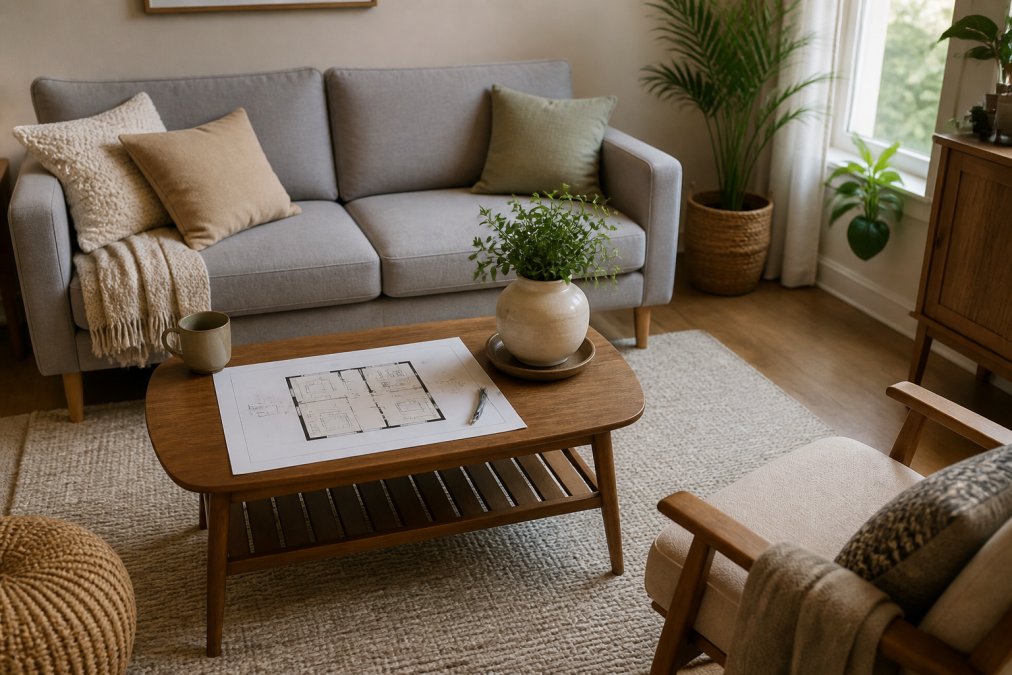
The single biggest mistake in small living rooms is buying furniture before mapping the room. A floor plan turns guesswork into spatial planning, and it costs nothing but twenty minutes with a tape measure. This guide walks through a recommended process for styling a compact space.
Measure the room's length and width, note door swings, windows, and outlets, then sketch it to scale on graph paper or in a free planning app. Mark where traffic flow must pass through. That path decides everything else.
The 2/3 Rule for Furniture Placement
Furniture should occupy roughly two-thirds of the floor space, leaving one-third open (interiordesign.net). This balance of visual weight keeps a room from feeling either empty or cramped.
Anchor the main seating piece against the longest wall, then angle secondary pieces inward. A common mistake is pushing every item flat against the walls, which creates dead space in the center and makes the room read smaller, not bigger.
Traffic Flow and Negative Space
Negative space is not wasted space. It is the breathing room that makes compact living feel intentional.
Leave at least 18 inches between a sofa and a coffee table so people can pass and sit comfortably (apartmenttherapy.com). In transitional spaces that double as a hallway, keep a clear 36-inch path from door to door.
Choose Multi-Functional Furniture That Earns Its Space
Every piece in a small living room should do at least two jobs. A storage ottoman holds blankets and doubles as a seat. A nesting table expands for guests and tucks away after. A lift-top coffee table turns a single footprint into a workspace, a dining surface, and a hiding spot for remotes and chargers.
The trap is buying furniture that looks clever but only serves one purpose, which quietly eats floor area you cannot get back. Before you buy, run each candidate through a simple test: name the two jobs it performs, and name the piece it replaces. If you cannot answer both, it does not earn its space.
Match the Piece to the Job, Not the Aesthetic
Different multi-functional pieces solve different problems, and the right pick depends on which problem is actually squeezing your room.

- Storage ottomans and benches: best when clutter is the issue. Look for a lid that stays open on its own and interior depth of at least 12 inches, or you will not fit a folded throw.
- Nesting and gateleg tables: best when you host occasionally. Two or three tables collapse into the footprint of one, so you gain surface only when guests arrive.
- Lift-top coffee tables: best when the room doubles as an office. Check the lift mechanism rating and the raised height, most sit around 6 to 10 inches higher, which is comfortable for a laptop but not for dining.
- Wall-mounted drop-leaf desks: best when you need a workspace that disappears. A 30-inch-wide leaf folds flat against the wall and clears the floor entirely when closed.
- Sofa trays and armrest caddies: best when you need a surface for a drink but have no room for a side table.
Renter-Friendly and Budget DIY Options
Most design guides assume you can drill into walls and replace furniture at will. If you rent or you are working with a tight budget, the highest-value moves are the ones you can undo and take with you.
- Over-the-door and over-the-sofa organizers: fabric pockets hang over a door or sofa back to hold remotes, magazines, and chargers without a single hole.
- Stackable cube shelving: modular cube units can be arranged as a low console, a bench with cushions on top, or a vertical tower, and they break down flat when you move.
- Rolling carts and bar carts: a three-tier cart on casters becomes a side table, a bar, or a plant stand, and it rolls out of the way when the room needs to open up.
- Folding tray tables: the classic TV tray has been redesigned with sturdier tops and locking legs; a pair stores behind a sofa and sets up in seconds.
- Storage that hides in plain sight: lidded baskets under a console, a hollow bench by the entry, and a trunk used as a coffee table all add capacity without adding a visible cabinet.
The Foldable Wooden Sofa Tray is a good example of the principle in action. It clips onto an armrest for drinks and snacks, then folds flat when you are done, which means you skip a side table entirely.

Space-Saving Storage Ideas That Actually Work
Storage in a small living room works best when it goes up, not out. Vertical storage and floating shelves use wall height that otherwise sits empty, and they keep the floor clear for the pieces you actually want to see.
Vertical Storage and Floating Shelves
Mount shelves above the sofa, around the television, or in the corner behind a chair. Keep the lowest shelf at least 12 inches above seating height so heads clear it (bhg.com). Group items by height and leave gaps between objects, because a fully packed shelf reads as clutter.
Decluttering and Intentional Organization
Decluttering is a habit, not a one-time event. Set a rule: one item in, one item out. Baskets and lidded bins hide the everyday mess that open shelving exposes.
Best Colors for Small Living Rooms (and What to Avoid)
Light, low-contrast palettes make walls recede and rooms feel larger. A cohesive aesthetic built on two or three related tones, rather than many competing colors, does more for perceived space than any single paint choice.
- Warm whites and soft grays: reflect light and pair with almost any furniture
- Muted sage or clay: add depth without closing the room in
- One accent wall: creates a focal point when the rest stays light
Avoid dark, saturated colors on every wall and heavy contrasting trim, both of which visually compress a space. If you love a bold color, use it on a single accent wall or in textiles you can change.
Layer Lighting for Depth and Warmth
One overhead light flattens a room. Layering ambient lighting, task lighting, and accent sources builds depth perception and makes a small space feel considered rather than dim.
Aim for at least three light sources at different heights. A flush-mount ceiling fixture handles ambient light, a floor lamp adds a warm corner glow, and a small table lamp provides task lighting for reading. The Compact Ceiling Fan with Light & Remote combines overhead light and airflow in one flush-mount fixture, which saves ceiling space in low rooms.

Get the Color Temperature and Dimming Right
Light color is measured in kelvin (K), and the number you choose changes how a room feels more than the fixture style does.
- 2700K (warm white): the standard for living areas; flatters skin tones and wood finishes and reads as cozy rather than clinical.
- 3000K (soft white): slightly crisper, useful over a desk or reading chair where you want focus.
- 4000K and above (cool white/daylight): best avoided in living rooms; it washes out warm textiles and makes compact spaces feel like offices.
Dimming matters as much as temperature. A dimmer on the main fixture lets the same room shift from bright for cleaning to low for evening, which is the cheapest way to make one room feel like several. Look for bulbs marked dimmable, standard LEDs can flicker or buzz on a dimmer switch.
Hide the Cables and Mount the TV
Small rooms expose every cord, and a tangle of cables reads as clutter even when the rest of the room is tidy. A few low-cost moves clean up the visual noise.
- Cable raceways and cord covers: adhesive channels run along the wall or baseboard and can be painted to match, hiding the run from an outlet to a TV or lamp.
- Wall-mounting the TV: removing a TV stand frees the floor beneath it and lets you use that wall for a slim console or floating shelf. Check the mount's weight rating against your TV's listed weight before you buy.
- A single power strip with a switch: plug lamps, chargers, and the TV into one strip you can reach, so you can kill standby draw and cut the number of visible cords.
- Cord-hiding furniture: consoles with a back panel and cable cutouts, or a hollow bench, let you drop cords out of sight without any wall work.
Smart-Home Control in a Compact Footprint
Smart lighting is one of the few upgrades that adds function without adding floor space, because the control lives in an app or a voice assistant rather than a new piece of furniture.
- Smart plugs: the cheapest entry point. Put a floor lamp or string lights on a smart plug and schedule them to come on at dusk, so the room is lit before you walk in.
- Smart bulbs: let you change color temperature and brightness from your phone, which means one lamp can be warm and dim in the evening and bright and neutral for a task.
- Scenes and routines: grouping several lights into a single scene lets you switch the whole room from "reading" to "movie" with one command, which is far easier than walking around to three switches in a tight space.
- Voice control: a small smart speaker on a shelf replaces a stack of remotes and keeps the surface clear.
Use warm bulbs in the 2700K range for living areas. Cooler light reads as clinical and washes out the cozy feel most people want at home.
Style the Finishing Touches: Rugs, Mirrors, and Window Treatments
Finishing touches are where a small living room stops looking like a storage solution and starts looking styled. Rugs, mirrors, and window treatments control how the eye moves and how much natural light the room keeps.
Choose an area rug large enough that at least the front legs of your seating sit on it. A rug that is too small visually chops the room into pieces. The Modern Geometric Washable Rug is stain-resistant and machine washable, which matters in compact rooms where the rug takes real traffic.
Hang a mirror opposite or adjacent to a window to bounce natural light deeper into the room. For window treatments, mount curtain rods close to the ceiling and extend them wider than the frame so windows read taller and wider than they are.
| Finishing Touch | What It Does | Quick Rule |
|---|---|---|
| Area rug | Defines the seating zone | Front sofa legs on the rug |
| Mirror | Reflects light, adds depth | Place opposite a window |
| Window treatments | Makes windows look larger | Rod near ceiling, wider than frame |
| Sofa tray | Adds surface on demand | Fold away when unused |
Common Mistakes That Make Small Living Rooms Feel Smaller
Most small living rooms do not feel small because of square footage. They feel small because of a handful of fixable choices.
- Pushing all furniture against the walls: kills the seating zone and wastes the center
- Buying a rug that is too small: fragments the floor visually
- Overfilling shelves and surfaces: adds visual weight with no function
- Relying on one light source: flattens depth and darkens corners
- Choosing oversized furniture: a sofa that is too deep crowds the walkway
Fix these and the room usually reads larger without a single renovation. If you are coming from a bigger space, expect to downsize at least one major piece; the trade is worth it.
Frequently Asked Questions
What are some common small living room mistakes?
The most common mistakes are pushing all furniture against the walls, choosing oversized pieces, and blocking traffic flow. Avoid heavy window treatments that cut natural light, and don't skip vertical storage. Using a rug that's too small or ignoring the 2/3 rule for furniture placement can also make a room feel cramped. Instead, pull furniture slightly away from walls, use multi-functional pieces, and keep pathways clear to create a sense of openness.
What is the 2/3 rule for living rooms?
The 2/3 rule suggests that your main furniture pieces, like the sofa and chairs, should occupy about two-thirds of the room's width or length, leaving one-third as open space. This balance prevents the room from feeling overcrowded and maintains good traffic flow. For example, in a 12-foot-wide room, aim for furniture to span about 8 feet, leaving 4 feet of open floor. This guideline helps with small living room furniture layout and makes the space feel intentional.
What colors are best for small living rooms?
Light, cool neutrals like soft white, pale gray, and light blue reflect natural light and make walls recede, creating an illusion of more space. Warm whites and greige also work well. For contrast, use a single accent wall in a deeper shade like navy or sage green to add depth without overwhelming. Avoid dark, saturated colors on all walls, as they can make the room feel closed in. Pair your palette with light flooring and airy window treatments for the best effect.
How can I maximize storage in a compact living area?
Use vertical space with floating shelves, tall bookcases, and wall-mounted hooks. Choose furniture with built-in storage, like an ottoman that opens or a coffee table with drawers. A foldable wooden sofa tray adds surface area without permanent footprint. Keep clutter off surfaces by using baskets and bins. Regularly declutter to maintain a minimalist look. These space-saving storage ideas help you get the most from every square foot.
Small living rooms ask for discipline, not sacrifice. Modern Goods Living curates space-saving essentials built to last, from the Multifunctional Height-Adjustable Bedside Table to foldable sofa trays and washable rugs that hold up to daily life. Get started with Modern Goods Living and turn a compact room into a space that works as well as it looks.
